NEW RESEARCH RESULTS FOR
DR34
Three
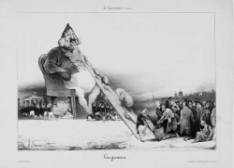
groups of people can be distinguished in this image: The people on the right
side, the members of government at the center and the parliamentarians on the
left. The latter look upwards and hold their hats expecting to catch the
falling coins and rewards. It is interesting that neither the coins nor the
hand of the king are visible. The lines suggest that his hand with the purse
was covered subsequently with the armrest to make the "gifts" under
the chair appear more visible.
The
creation date and the proposed allocation to La Caricature are
occasionally questioned. It is certain that the December 15, 1831 edition of La
Caricature contained only the lithographs „Mr. Croupion“ by Audibert
/ Delaporte and "Précautions inutiles" by Wattier / Philipon -
but not "Gargantua". Also on December 16 there were two
lithographs - but not "Gargantua" - which could indicate that this
print was planned from the outset as a separate product. Daumier's first
lithograph for La Caricature was actually published only on February 9,
1832 - nearly two months later (see DR40).
In the
literature, this lithograph is seen as a prime example of Daumier’s fearless
attitude towards the king and the corrupt July-monarchy. The details of his
arrest, trial, conviction, etc are considered as facts and are repeated in each
new text on this subject. But it seems that no author has ever researched and
cited the primary sources, ie, the Daumier case file.
Daumier as
author, Delaporte as printer and Aubert as print dealer were standing before
the circuit court in Paris on February 22, 1832 (and not on February 23, as is
always indicated). They were accused of incitement to hatred and contempt of
the government, the head of state, and the king. The Gazette des tribunaux
of February 23, 1832 reported briefly on the last page that Delaporte and
Aubert rejected any responsibility; Daumier asserted to have had no evil
intentions and ascribed everything to his youthful foolishness: his Gargantua
being not even a caricature of the king, but the general symbol of corruption.
The very fact that he is just dressed like all other people is proof of this.
The jury did not accept this justification and declared all three defendants
guilty. Thereafter, the court sentenced them each to 6 months in prison and
fines of 500 francs. The court dealt on the same day with the lithograph DR32.
The indictment was identical, but in this case the jury declared the accused as
innocent. An appeal would have been futile because the decision of the jury
could not be changed, only procedural flaws could possibly result in a new
trial. On February 28, 1832 Daumier, Aubert and Delaporte submitted a request
for clemency, which the very devoted king might benevolently and positively
grant to his humble and obedient servants, according to the tenor of the
letter:
«Sire,
Trois hommes qui n'ont jamais été animés contre vous d'aucun sentiment de haine
viennent d'être condamnés à six mois de prison pour une caricature dans
laquelle le jury a crû voir une offense à votre auguste personne.
L'artiste, jeune homme de vingt trois ans, n'avait mis aucune importance à un
dessin qui lui semblait inoffensif; l'imprimeur a cru sa responsabilité à
couvert par la signature du dessin, par la formalité du dépôt et par le nom de
l'éditeur, celui-ci, père de famille et marchand, n'a pas pensé qu'il pût être
compromis par une caricature, ou il ne voyait rien qui lui parût personnel à
votre majesté.
Sire, ils s'adressent à vous pour les sauver d'une captivité qu'ils n'ont pas
méritée par leurs intentions, et qui les plongerait eux et leurs familles dans
une ruine et un malheur irréparable.
Plein d'espoir en votre générosité, ils attendent, Sire, l'arrêt que vous allez
prononcer.
Vos très humbles et très obéissants serviteurs»
Aubert, Delaporte et Daumier
Ironically,
it was in his debut for La Caricature (DR40) that Daumier ridiculed the
submissive elite. The caption reads: „très humbles, très soumis, très
obéissans ...“. The appeal for clemency filed as BB/21/373/4172/S8 in the
National Archives resulted in May 1832 with an amnesty for Aubert and
Delaporte; Daumier however was imprisoned. He was allowed to spend the period
from November 10, 1832 to February 22, 1833 in the Psychiatric Hospital "Chaillot"
with Dr. Scipion Pinel. This was however neither due to his mental
state, nor was he a special case. Already during the restoration an insightful
political prisoner was occasionally allowed to apply for transfer to a
hospital.
By the way,
it should be noted that a dozen lawsuits against La Caricature, Le
Charivari and their employees can not always be regarded as harassment or
even as persecution by the government. Newspapers like La Tribune, Le
National, even the legalistic La Gazette de France were seized
countless times and their editors punished. Satire, however, particularly in
the form of ambiguous lithographs was not so easy to pin down.
Dr.
Scipion Pinel
(1795-1859) was a psychiatrist and son of the famous physician Dr. Philippe
Pinel (1745-1826), who particularly advocated humane and scientifically
oriented psychiatry. His academic authority and his successful treatments with
prisoners resulted in the release of mentally ill people from their chains. His
son Scipion was known for the court-approved counseling and treatment of
prisoners that were soon to be released. He succeeded in this
"disguise" to grant protection to several opponents or to facilitate
their conditions of detention.