BRONZE SURMOULAGE (COPY).
This section deals with bronzes, which do not carry a number or foundry stamp, thus making it difficult to identify the producer / foundry of a sculpture. A surmoulage is a bronze reproduction from an already existing sculpture. In 1965, the plaster used for the Barbedienne and Valsuani editions had been destroyed by the editor Le Garrec. Nevertheless, this had only little impact on the number of reproductions, which still appeared on the market. It was still possible to produce a copy (surmoulage) from an already existing Barbedienne bronze and delete the number and markings. Guy Hain, a notorious forger of Rodin busts produced a few Daumier busts of remarkable quality, which carried neither a number nor a foundry cachet (see our remarks below under: “Original or not“). It should also be noted that in a few cases two bronzes with the identical number appeared twice - as seen for example in an auction in 1998 - while at the same time being part of the collection of a well-known Museum. These “irregularities” are being pointed out in the relevant sections of the Daumier Register whenever they occur.
Some of the surmoulage copies carry a monogram (H.D.) in various forms and sizes. They are usually, like in the case of “Pataille”, slightly heavier and smaller than the so-called “legal copies” due to the mould shrinkage in baking and consequent loss as a result of the drying process of the bronze. Occasionally, “Pataille” and “Viennet” sculptures can be found without a number or cachet. They are not necessarily surmoulages, but original Barbedienne editions. These were models, which had been rejected or were used as trial copies by the foundry. Wasserman stresses (pp. 26/27) that “the exact number of bronzes, even in a numbered edition is often greatly confused by the appearance of unnumbered trial proofs. Some of these had been marked “E.E.” even “0” or “HC”. Some of them did not carry any initials or number at all and were not supposed to be sold on the market.” (see an example here below)
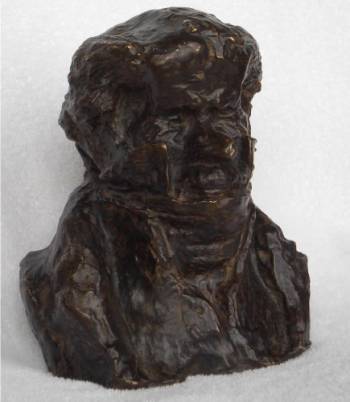
Already in 1943, Le Garrec complained about illegal copies of “Viennet”, followed later by illegal copies of “Pataille” and in 1948 by “Philipon” (DR9635). These usually carried no foundry mark or number, but only, in contrast to the trial copies, the monogram H.D.
Apart from the surmoulages in bronze there exist numerous copies using materials such as resin, plaster, plastic, metal legations etc. They can differ in size, monograms and numbering. Most of them can be found under the section “Fakes and Imitations” in the Daumier Register. We are not aware of any bronze surmoulage of this bust having been offered on the market.